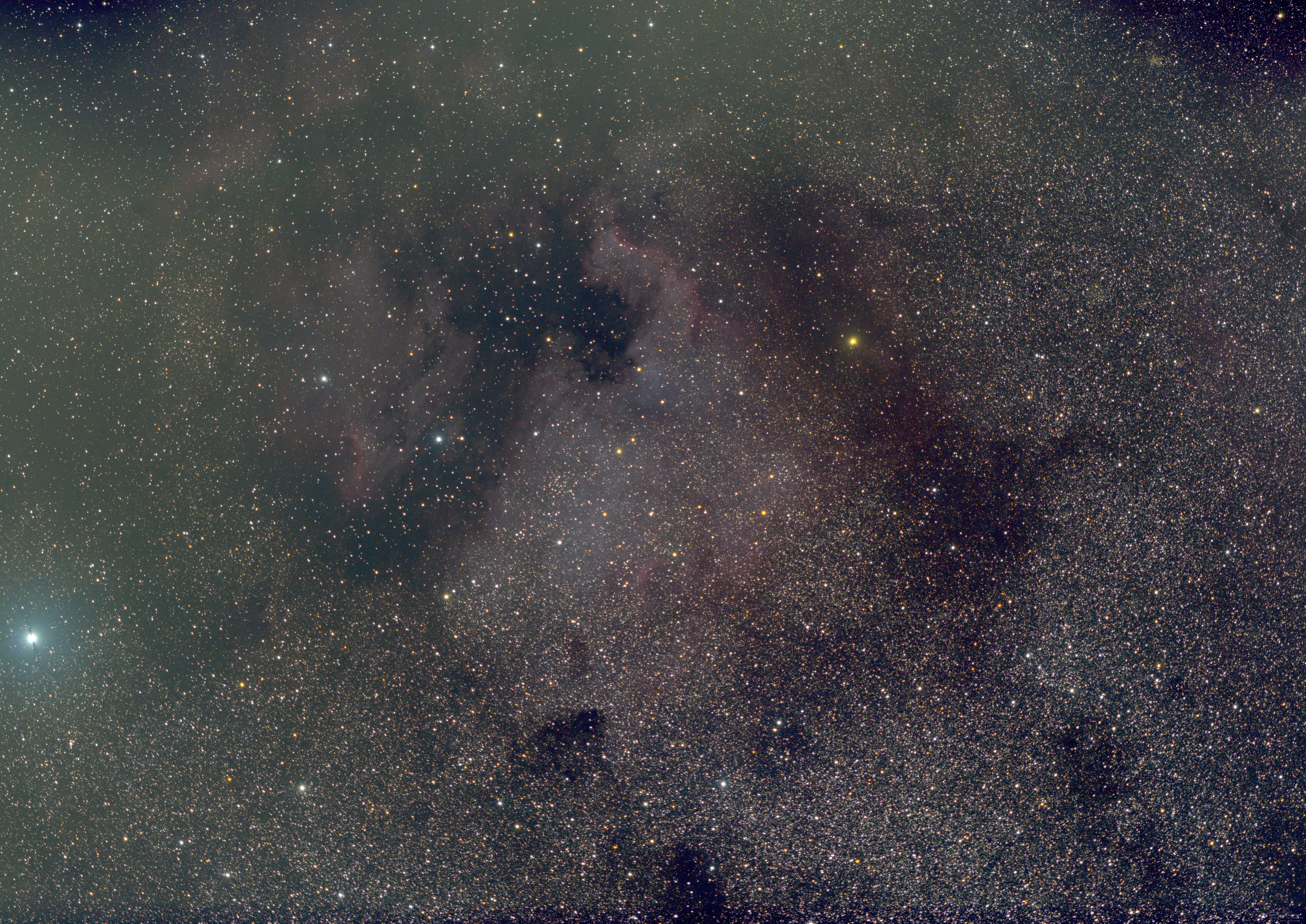
| Object : | NGC 7000, North America Nebula |
| Coordinates/Direction : | RA: 20h59m, DEC: +44o31' |
| Object size : | 120' x 100' |
| Object magnitude : | 4 |
| More to know : |
Wikipedia:
https://en.wikipedia.org/ wiki/ North America Nebula |
| Exp. time : | 30x240 seconds, iso400, every third dithered |
| Image process tool : | Siril, Gimp, Irfanview |
| Processing : | flat, photometric color calibration |
| Weather : | clear sky, full moon, temperature +5o C |
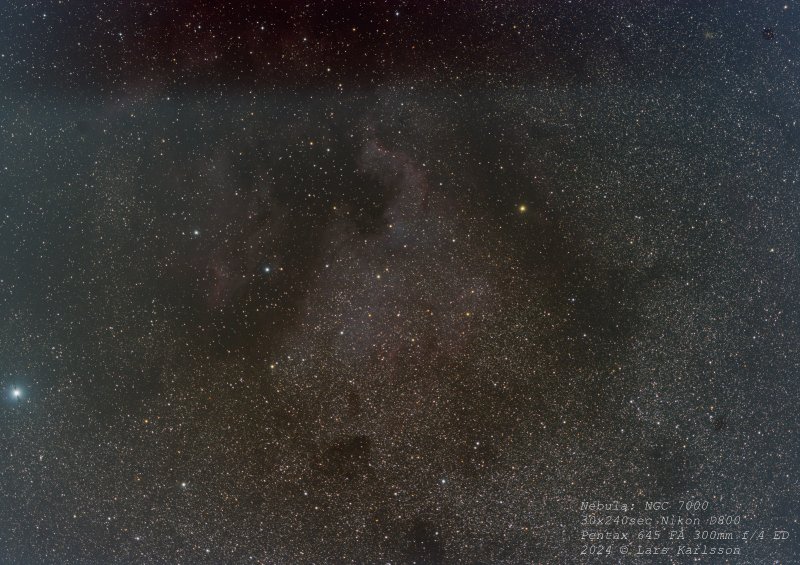
| Comment : |
We had a clear sky with a full moon.
Very disturbing but clear skies are not common and we wanted to take more astrophotos, this is a very bright object. |
| Date : | 2024-11-16 |
| Processing : | new flat, photometric color calibration |
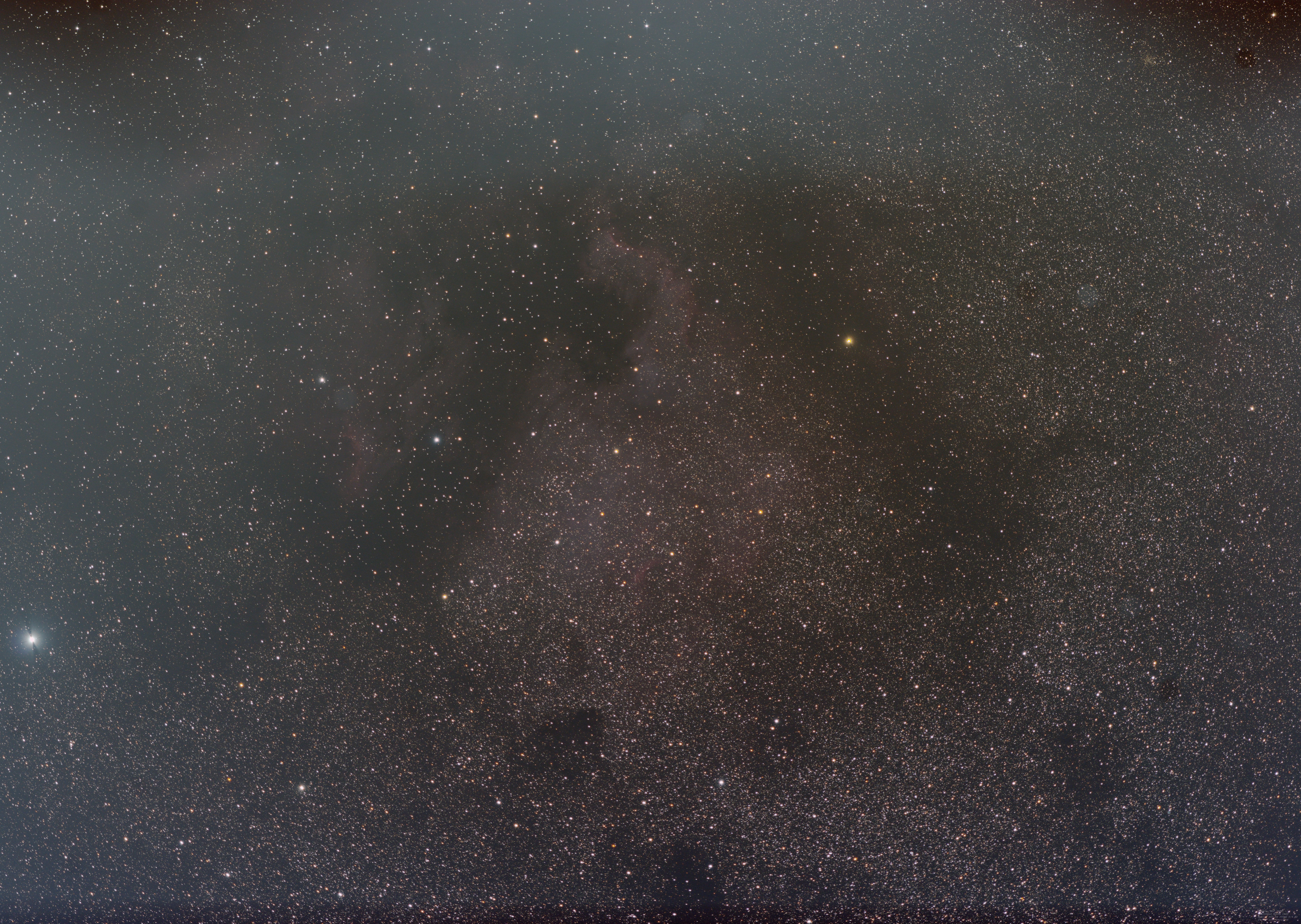
| Comment : |
Some problem in the upper part of the photo.
Now I'm sure that is from the off-axis adapter.
I have adjusted the mirror for the off-axis and put on a black tape on the backside to reduce the internal reflections.
Still some problem in the upper part, but better now and even better next time I take a photo. |
NGC 7000 2024-11-07
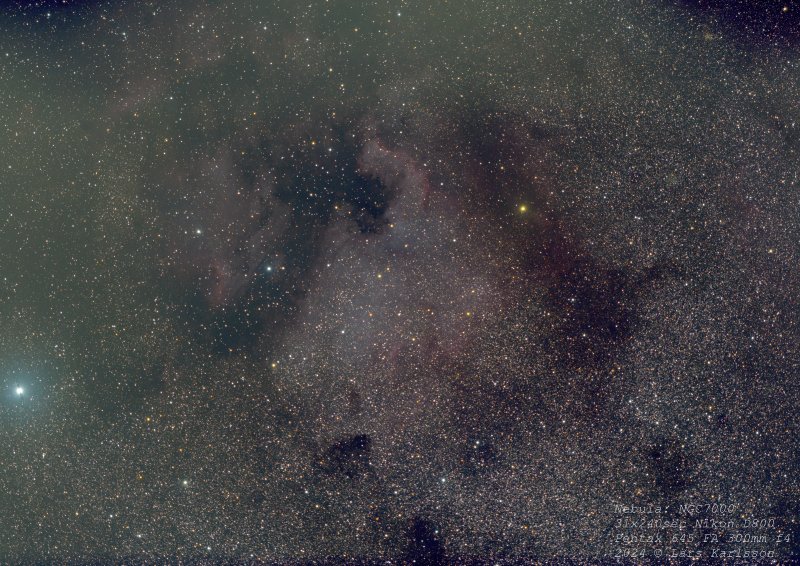 (Click on image to get one in full resolution in a new window)
|
| Date : | 2024-11-07 |
| Time (UT) : | 19:43 to 21:25 |
| Mount : | SkyWatcher HEQ5, belt modified, low rider |
| Guide : | ASI120 camera with off-axis |
| camera : | Nikon D800, QE=0.56, full frame, 36 Mpixel, 14 bit |
| camera temperature: | - , no temperature sensor |
| Film/CCD : | Raw, NEF |
| Filter : | none |
| Exp. time : | 24x240 seconds, iso400, every third dithered |
| Image process tool : | Siril, Gimp, Irfanview |
| Processing : | flat, photometric color calibration |
| Weather : | clear sky, temperature +3o C |
| Comment : |
Almost a perfect night.
At the upper part of the image can be seen something that shouldn't be there.
I think it's from the off-axis adapter that protrude into the light beam.
It can also be a light lekage, but I think I sealed the optics from that earlier.
I will take better flats to calibrate with later. |
NGC 7000 2023-03-28
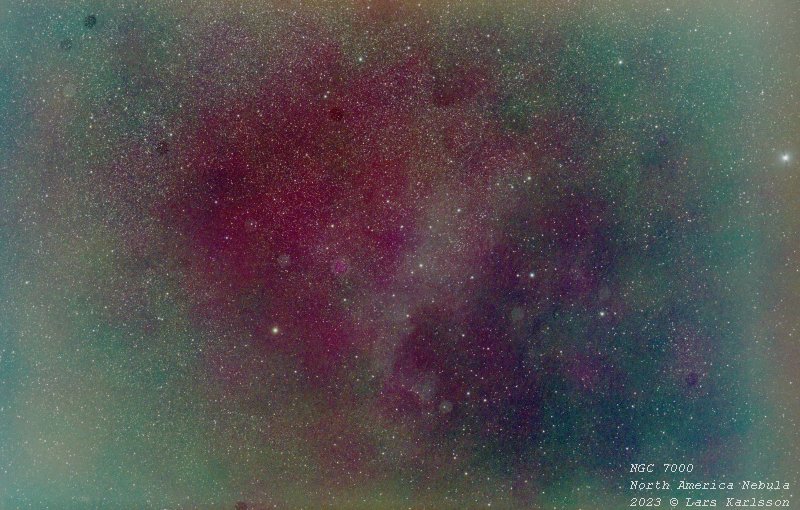
|
| Date : | 2023-03-28 |
| Time (UT) : | 22:57 to 00:08 |
| Mount : | SkyWatcher HEQ5, belt modified, low rider |
| Guide : | QHY5 camera with 200 mm f/3.5 lens |
| Lens/telescope : | Pentax 645 300 mm ED f/4 (medium format lens) |
| Corrector/Barlow : | - |
| Field (FOV) : | 6.8x4.5o (full frame) before crop |
| camera : | Canon 6D, QE=0.5, full frame, 20 Mpixel, 14 bit |
| camera temperature: | About 6o C above surrounding temperature |
| Film/CCD : | Raw, Cr2 |
| Filter : | none |
| Exp. time : | 77x30 seconds, iso1600, dithering mode |
| Image process tool : | Siril, Gimp, Irfanview |
| Processing : | cal dark (const), flatcrop, desaturated, color calibration |
| Weather : | clear |
| Site : | Sweden, Stockholm, Hagsätra.
Bortle 9
Free view Az: 20o to 90o, 165o to 185o, Alt: 20o to 55o |
| Comment : |
It's not many weeks left of this astronomy season.
Desperately I looking fore something exciting to photograph.
In Northeast very low to the horizon I see that the nebula NGC 7000 climbing up.
When I start photographing it it's only 19 degrees above the horizon.
But it's a very big nebula with its 120 x 100 arc min size, bright too with magnitude 4.
Nebulas is almost impossible to photograph when there are heavy light pollution without narrow band filter.
This photo isn't very nice, but I can take a new later when out on a dark place.
This was also the first photo that I processed with desaturate tool in Siril of the over exposed stars and after that color calibrated the stars. |


 English

 (Click on image to get one in full resolution in a new window)
 (Click on image to get one in full resolution in a new window)